

Why AI has made bespoke software worth owning for mid-market companies, and why a business that wants AI everywhere needs its own system of record.
ExaDev is best known for working with startups, but this year we've also been building custom software for mid-market and challenger companies, and enquiries of that kind have risen sharply. My reading is that bespoke software now fits within the time and money a company of that size can commit, where until recently it didn't, or the company wouldn't take the risk.
I think there are two reasons. The first is affordability. AI has made writing code much cheaper and faster, so a company sees working results before it has committed much, though cheaper code is not cheaper software engineering. The second is that these companies want AI working across the whole business, to serve their customers and to compete and scale without adding headcount, and that needs a system of record the company controls, with plumbing into every product it buys.
What I expect to follow is that more of these companies buy focused products for standard jobs and put their money into the part no vendor can sell them: a system built around how the business actually works, which no competitor can use.
The suite was already bespoke
Bespoke software has always fitted a particular business better than software designed for the average one. The difficulty was that it was expensive to build, risky to deliver and needed looking after for years, and few mid-market companies had the budget for that or any wish to run a software team. The alternative was an all-in-one suite, and buying one was a rational trade of fit for safety.
In practice a suite of the SAP-style kind is rarely used as it comes. An integrator configures, extends and connects it over months, sometimes years, until it fits the business well enough to be usable. The result is bespoke software in all but name, written at day rates on a base the client doesn't control, with parts of it redone whenever the vendor ships a major upgrade. The real comparison is therefore between bespoke software delivered through an integrator and bespoke software built for the business from the start, and a good deal of the suite's safety turns out to be familiarity.
What AI has changed, and what it hasn't
Building software a company owns takes two things, writing code and the judgement around it, and AI has made the first a commodity. The second is most of the job and was never visible to a buyer: deciding what to build, getting know-how out of a few senior people's heads and into a system, designing a data model that lasts, keeping the system maintainable, and answering for it when it is wrong. A company that treats cheap code as cheap software tends to find out the difference in production, and my impression is that companies which sold coding capacity by the hour are exposed, because the visible part is what they sold.
What AI has changed most is the start. Companies feared the build: a large commitment up front, and months before there was anything to look at. A working first version can now be in front of the people who will use it within weeks, so a company sees what it is getting before it has committed much. I think that, more than the lower cost, is what has persuaded mid-market companies to build their own software where they previously wouldn't.
The start is also where the gain is largest, and something that looks the part is not yet something that can be relied on. Every project slows as it matures, because each change is made on top of a growing pile of earlier ones, and how much it slows depends on how well that pile is organised. A maintained codebase slows gently and a neglected one slows steeply. AI sharpens this, since it copies the patterns it finds, good and bad. That is the year-three problem: the people who built it have moved on, nobody is sure how it works, and every change risks breaking something. The discipline that prevents it has long been known: test every change, release in small steps, and record the reasoning where the next person (or agent) can find it. AI has made that discipline cheaper to apply, but it doesn't apply it unasked. I've written about the productivity curve in Do we still need experts?, and about what the discipline looks like for us in We engineer with AI. We don't vibe code.
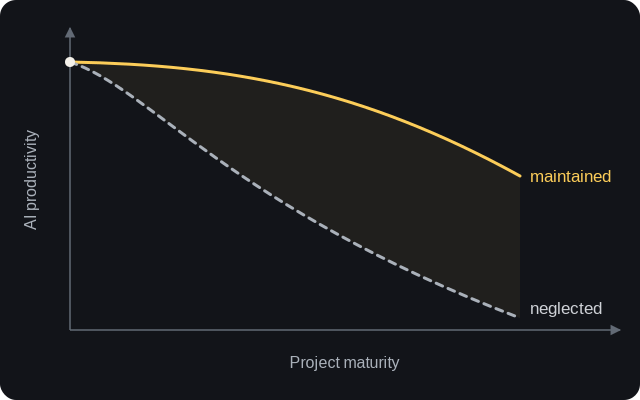
Together, the faster start and cheaper discipline are enough to alter the comparison with a suite.
AI across the business
Each SaaS vendor is adding its own AI assistant, and each one sees only that vendor's data. That is useful within a product, but what most companies want from AI crosses products. Broadly, they want to serve their customers well and to scale without adding headcount, which together are how a challenger company competes on price and speed with companies several times its size.
Some of that is answering questions that cross products: whether a slipping project will affect this quarter's cash, or which customers are worth more than their invoices suggest. Increasingly it is work: drafting quotes from past jobs, chasing invoices, rebuilding a schedule when a project slips, reconciling records between systems. AI that acts has to write as well as read, and either way it needs one model of the business underneath it. This is close to a view that has become common this year, usually put as renting the intelligence and owning the context. What that leaves out is that owning the context is mostly a software engineering job.
The middle
The system of record is the company's own data model, joined up across everything it does. Bought products remain the record for their own domains (the ledger stays in the accounts package, payroll in the payroll product); what is specific to the company, and the view across all of it, belongs to the company. Companies have long had records of a kind and used them for reporting. To carry AI across the business it has to be AI-native, built for AI to read and act on: facts can be traced to their source, decisions are kept with their reasoning as data, calculated values come out the same way each time, and there are controls on what an assistant can read and change.
Plumbing is easily mistaken for integration tools, so an example helps. A contractor might keep its own central record of jobs, customers and people, connected to the products it buys for site work, customer relationships and finance. The plumbing is the company's own connective layer at the edge of that record: how a record in each bought product maps to the company's model, how the two are reconciled when they disagree, and what is allowed to write back. It stays bespoke, because it encodes how this particular company works, and it has become affordable because the code is cheap to write. It is also where the company governs its AI, deciding what an assistant can read and act on, product by product, without accepting each vendor's defaults.
What is standard is each product's own API, and vendors opening up helps. But access to each product is not one joined-up model of the business. Integration tools and low-code automation sit in between, and I think they belong to the period when code was expensive. They let a company connect products without engineers, at the cost of control: the logic lives on a rented base where it is hard to test, version or govern, which is the integrator's bargain again on a smaller scale. With code cheap, a company can write the plumbing that matters directly against the APIs and keep that control, and leave such tools to small automations at the edges. None of this is a new idea. A decade ago plenty of companies bought the best separate product for each job and wired them together, and often ended up with a fragile web of connections that nobody owned and everybody blamed. The idea may well have been right the first time, and simply cost too much.
Know-how is what the company sells: how to price a job, which approaches work, where projects tend to go wrong. In most companies it sits with a few senior people and is applied where they have time to look. Captured in a system, it is applied on every job, and no vendor can sell it, because no vendor knows how the company works.
By the middle I mean the system of record, its plumbing, the company's know-how, and AI working across them. Put plainly, the company owns its know-how, its data, and how AI integrates with the business. I'd argue that is also what the suite was really selling.
Not all SaaS is created equal
None of this necessarily means the end of SaaS, whatever the SaaSpocalypse commentary suggests. Jim Barksdale, who ran Netscape, is often quoted as saying there are only two ways to make money in business, bundling and unbundling, and enterprise software has spent the best part of twenty years bundling. What is being read as the death of SaaS looks to me more like an unbundling, and much of the doom treats SaaS as one thing, when it is several quite different things.
Two kinds look as worth buying as ever. Single-function SaaS, which does one standard job for every industry, such as payroll and accounts, remains the obvious thing to buy. So do tight vertical products that carry expertise in a single domain, which a company would otherwise have to rebuild as knowledge as well as code; they are still worth buying, and sit comfortably alongside a company's own system of record. The pressure falls on the all-in-one suite as a product model, and on the integrator work around it, mainly in the mid-market and among companies choosing a system for the first time. That is a claim about one way of selling software, not about large vendors as businesses, most of which will adapt.
A map
On a simple Wardley map, the vertical axis is the value chain, with the company's chief executive at the top, what they need from their software beneath, and below that, parts progressively less visible to the buyer. The horizontal axis is evolution, from genesis through custom-built and product to commodity. Position on it reflects how standardised a need has become, not what it costs: payroll sits towards the right because every company needs much the same thing, and something can be cheap to build and still sit on the left. Payroll and accounts products stop short of commodity because they hold the company's records, so switching is costly and suppliers are not interchangeable in the way that code generation now is, which is the same reason a company should own its own system of record. The map is a snapshot of what has moved so far, not a forecast of where everything ends up.
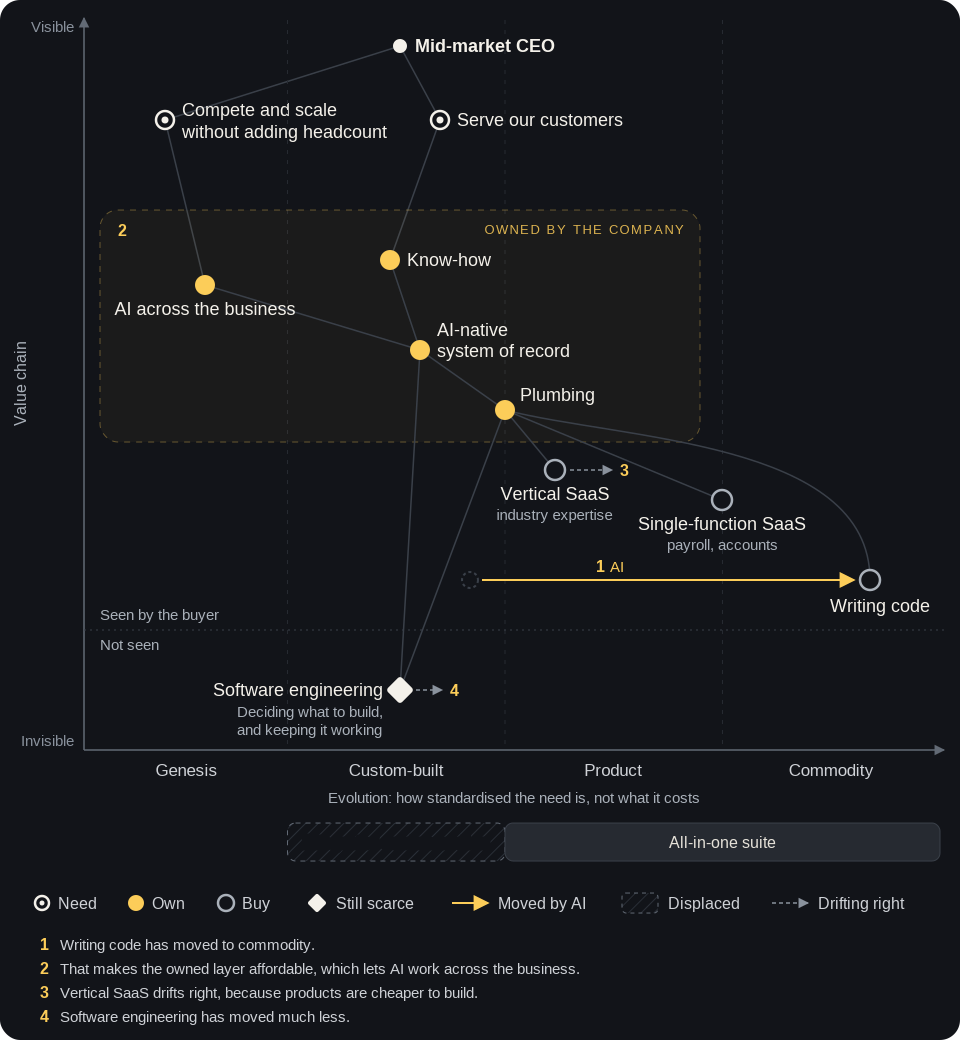
What the company owns sits in the middle of the map, between what its chief executive needs and what it buys in. The numbers mark what has moved. AI has moved writing code from custom-built to commodity (1), which makes the owned layer affordable to build and keep alive and lets AI work across the business (2). Vertical SaaS is drifting right as products get cheaper to build (3); it and single-function SaaS are different kinds of product, neither turns into the other, and the suite competes with both. Software engineering has so far moved much less (4), and the system of record and the plumbing need it directly, so the owned layer became affordable without becoming a commodity. The integrator's custom work, which stretched the suite into custom-built, is the part a company can now own instead.
The natural question is why AI doesn't push everything to the right. My answer is that cheap is not the same as commodity. AI lowers the cost of making software, but it doesn't make every company want the same software. Much of the pressure to standardise came from the cost of custom work, so removing that cost lets more of a business stay bespoke. The model is the commodity; the company's context is not. Differentiation is also relative, so as one thing becomes standard, companies compete on the next, and the left of the map never empties. The objection does land in two places, and I'd concede both. Vertical SaaS will probably be pushed further right as products get cheaper to build, and know-how that is really public knowledge will be eroded by a general model that already has it.
An example
The clearest example I can give is a platform we've been building with a UK independent connection provider, whose engineers design the high-voltage connections that plug new renewable and storage projects into the grid. It chose to build its own platform, with much the same instinct that led Octopus Energy to build Kraken.
In the terms of the map, it started with know-how. As in many engineering companies, knowing how to apply the right documents to a design had tended to sit with a handful of senior engineers, and the platform makes that knowledge available to the whole company. We've shipped more than 1,500 releases to production since July, which works out at more than ten a day. The platform's AI cites its source or says it doesn't know, and across every run so far it has never once invented a citation. The code, the cloud account and the data have been in the client's name since the first week. The client also required that the model provider could be changed without rewriting the logic.
The next phase extends the same platform into wider project delivery, so the reasoning behind decisions stays with the company. That is the know-how growing into the system of record. The full case study goes into more detail.
Who looks after it
The objection I hear most often, and take most seriously, is about what happens after the build: being left with something nobody understands once the builders move on. Part of the answer is ownership. If the company owns the IP, the code and the accounts it all runs on, bringing the work in-house or moving it elsewhere is a realistic option at any point, and that keeps whoever builds it honest. Ownership only means the company can leave, though. The rest is maintainability: a system built with the discipline that keeps it cheap to change leaves whoever looks after it next with something they can work on. I'd be wary of anyone offering one without the other.
What the company ends up owning
I don't expect the suites to disappear. For large enterprises with substantial IT departments, and for companies that genuinely work much like everyone else, they will remain a sensible choice. In the mid-market, though, I'd expect more companies to buy the focused products and put their money into the middle. What they end up owning is something no vendor can sell them and no competitor can use. In Barksdale's terms that is a rebundling, done by the company on its own terms, around how it actually works.
Thanks to Jaz Chana for being my Wardley mapping partner on this.